
The Untold Story of Selling the Sky to Save History
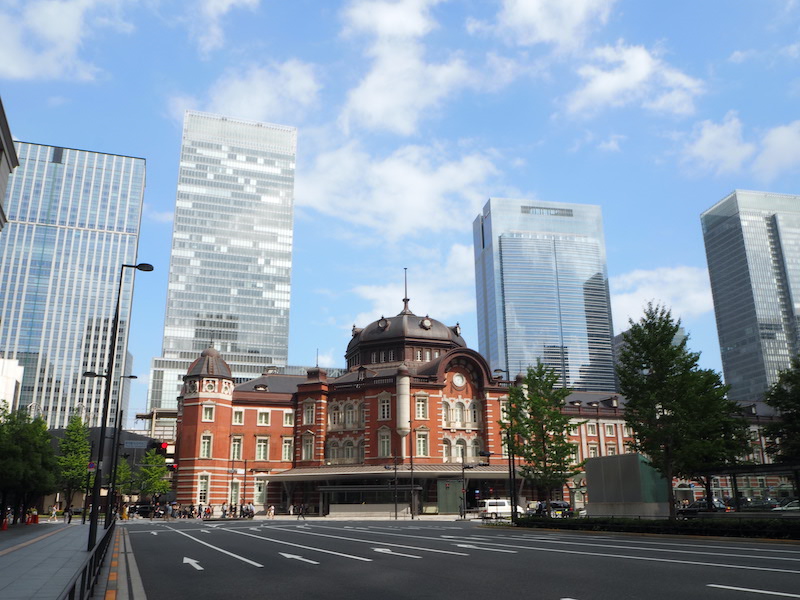
Tokyo Station is far more than just a massive mega-station where millions of people pass through every day. Step outside, and you are greeted by a grand avenue leading straight to the Imperial Palace, the very heart of Japan. Above all, it stands as a breathtaking, historic red-brick monument that captivates anyone who looks upon it.
Today, we dive into the incredible story of “selling the sky“—the ingenious business strategy that allowed this beautiful landmark to be preserved for future generations.
The Red-Brick Station Building: A Symbol of Japan’s Modernization
The Marunouchi Station Building at Tokyo Station was born over a century ago, in 1914 (the 3rd year of the Taisho era). It was designed by Kingo Tatsuno, famously known as the father of modern Japanese architecture. Blending Western architectural techniques with Japanese aesthetic sensibilities, he created a magnificent, three-story red-brick station building.
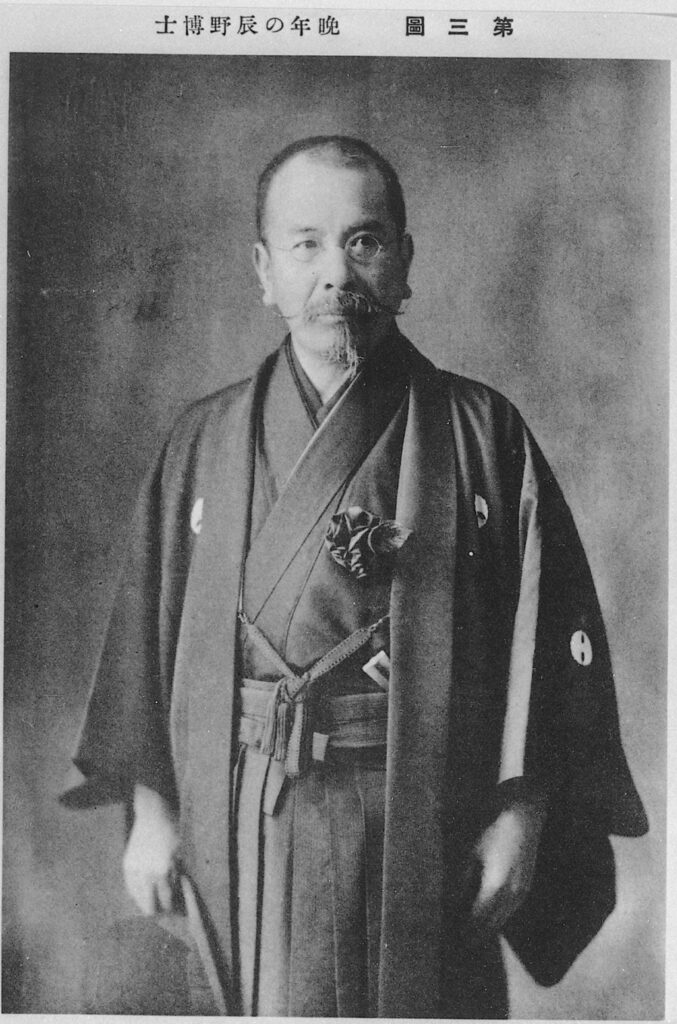
Kingo Tatsuno (1854–1919), the renowned architect who designed the original Tokyo Station building.(Photo: Public Domain)
However, during the air raids of World War II in 1945, the building’s third floor and its iconic domed roofs were destroyed by fire. In the postwar era, it was hastily restored as a scaled-down, two-story structure. As Japan entered its period of rapid economic growth, fierce debates erupted. Many argued that this prime real estate should be cleared to make way for a modern, high-rise station building.
An Astonishing Idea: Selling the “Sky”
How do you preserve historic beauty when the cost of restoration and maintenance is astronomically high? This seemingly impossible dilemma was solved by a highly unique financial and legal mechanism known as “air rights” (the transfer of floor area ratio).
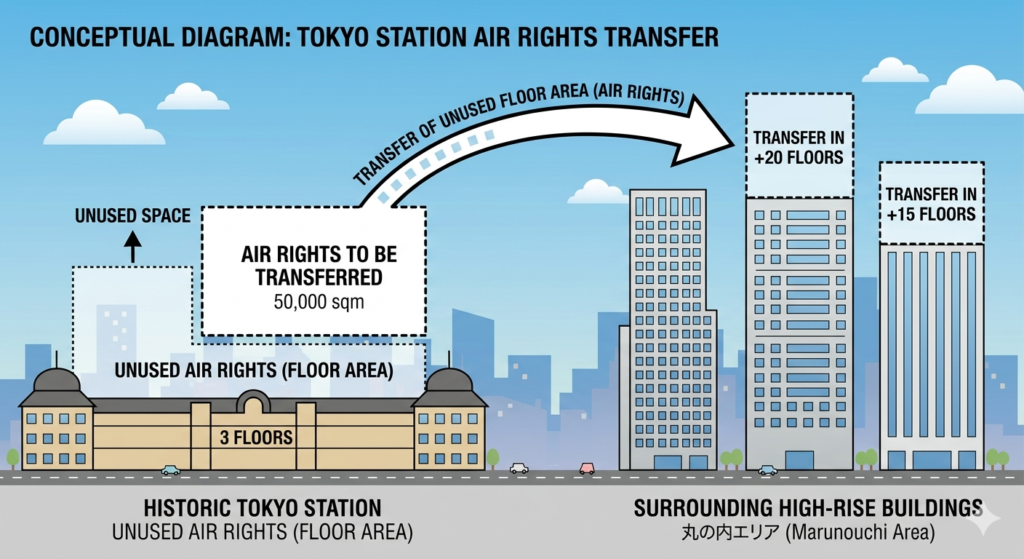
“Air rights” essentially encompass two key aspects:
Ownership of Space: The right to own and utilize the physical space above a property.
Sale of Rights: The ability to “sell” the unused building volume (floor area ratio) allowed on one’s land to another property owner.
Given its location in one of Tokyo’s most premium districts, Tokyo Station could legally have been developed into a massive, multi-story skyscraper. Instead, to protect the historic landscape, the building was kept at three stories. This meant the station possessed a massive amount of unused vertical space. The brilliant solution was to sell this “unused sky volume” to surrounding real estate developers.
The 2012 Full Restoration: The Numbers Behind the Magic
Thanks to this groundbreaking approach, Tokyo Station underwent a complete restoration in 2012 (the 24th year of the Heisei era), successfully resurrecting its original, beautiful three-story Taisho-era appearance.
Behind the scenes of this grand project lay a stunningly precise financing strategy. JR East sold Tokyo Station’s “air rights” to neighboring real estate firms and developers, including Mitsubishi Estate.
The total sales revenue reached a staggering 50 billion yen.
By funneling this revenue directly into the preservation and reconstruction costs, JR East achieved a flawless restoration of a historical monument while drastically minimizing its own out-of-pocket expenses. Meanwhile, the private developers who purchased these air rights (for iconic projects like the Marunouchi Building and the Shin-Marunouchi Building) gained the right to build their skyscrapers even higher than normally permitted under standard zoning laws.

A “Win-Win-Win” Solution for Everyone
This story represents the pinnacle of creative urban development.
For JR (The Railway Company): They secured the massive funding required for preservation and reconstruction that they could not have covered alone.
For Developers: They were able to build taller, higher-value skyscrapers in a prime commercial district.
For the Public & Tourists: We get to enjoy a breathtaking, historic Taisho-era red-brick landscape nestled beautifully at the feet of ultra-modern skyscrapers.
The next time you step out of Tokyo Station and walk toward the Imperial Palace, take a moment to look up at the blue sky above the station building. There, hidden in plain sight, lies the creative wisdom that saved a piece of Japanese history.